The Island
How cruel worlds learn to call themselves nature

The condition of man is a condition of war of every one against every one.
— Thomas Hobbes, Leviathan, 1651
Rust is a video game in which you wake up naked on a beach with nothing but a rock. No tools or shelter, no memory of how you arrived. Around you, other players are waking up in the same condition. The island is large and full of resources: ore in the rock, animals in the trees, abandoned structures stocked with materials. The question the game poses is simple. What happens next?
The answer, almost universally, is that someone hits you with a rock.
Within minutes of spawning, players begin killing each other. Within hours the first groups have formed, claimed ground, raised walls, and started breaking into the shelters of whoever has gathered something worth taking. By the end of a cycle the island’s resources sit in the hands of a few players and clans, while the rest spawn, gather a little, and lose it again to the same names, over and over, until the server resets and everyone begins from nothing on the same beach.
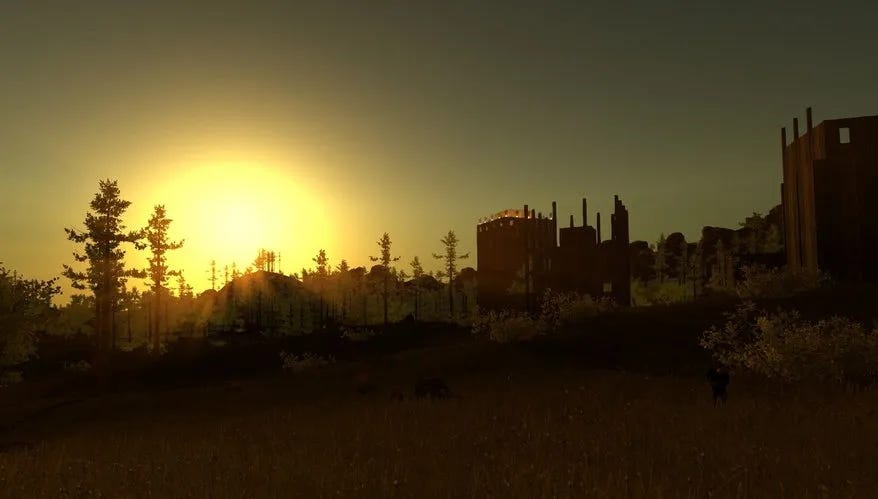
The man who made it did not set out to make a game about violence. Garry Newman said in 2014 the original idea was only to drop players into a world with nothing and no goal but to exist in it. When he was asked about adding systems to discourage the killing, ways to punish it or mark the killers, he said no.
“People should be nice to each other because they get a nice feeling from being nice. There shouldn't be a system hanging around forcing people to be good.”
He built the sandbox, set down those few rules, and stepped back to watch. What grew on every server, without exception, was war.
Thomas Hobbes wrote Leviathan in 1651, in the wreckage of the English Civil War, having watched an ordered country fall into factional killing. He described the state of nature: the human condition before government, before law, before any contract held behavior in place. There, he wrote, there is no industry, no culture, no knowledge, no arts, no letters, and the life of man is solitary, poor, nasty, brutish, and short.
Hobbes was theorizing. Rust built it, and ran it millions of times.
The conditions are exact. There is no law on the island, no state to appeal to when your shelter is destroyed or your body is taken for the stone in your pocket. No court, no police, no contract anyone is bound to keep. Every other player is a threat, because every other player lives under the same conditions and is looking at you the same way. The first hours of a server come close to an equal start, the resources spread evenly, every hand able to reach them. It does not stay that way for long. Groups form. Groups outgather individuals. The larger and better organized reach better tools sooner, guns for rocks, metal for wood, automated turrets for the work of staying awake, and the gap widens with every hour until, inside a single day, the server has produced something that looks unmistakably like a class structure. The armed clans at the top, behind metal walls and boxes full of other people’s hours. The solo players at the bottom, broken into faster than they can recover. The middle pulled up into the clans or taken apart by them.
The island has reproduced the first grammar of capitalism in approximately forty-eight hours: enclosure, accumulation, hierarchy, and the conversion of common ground into private force.
That much is easy to see, and most people who have played stop there, satisfied that the game has shown them something about money or property or the thinness of civilization. But the forty-eight hours are only the setup. The part worth staying for is what the winners do once they have won, and what the island does to all of them in the end.
I
The Cruelty of the Satisfied
By the third day the dominant clan has won. There is no real contest left on the server. They hold the best ground and the best weapons, and more stone and metal and sulfur than they could spend if the game ran for a month. The thing Hobbes blamed for the war, the scarcity, the insecurity, the impossibility of safety, is gone for them. They are safe. They have more than enough. By every logic that started the fighting, the fighting should now stop, but it doesn’t. It only changes its reason.
The clan keeps raiding. They break into bases that hold nothing they need. They camp the beaches where new players spawn naked with a single rock and kill them as they arrive, again and again, not to take anything, because a naked man on a beach has nothing to take, but because it is something to do. They build elaborate traps for people who could never threaten them. They hoard what they have already looted. The violence that began as survival has turned into entertainment, and the hunt goes on long after the hunger is gone, because the hunger was only the excuse that got the hunting started.
We understand the violence of the desperate, and we have forgiven it in every uprising and every cornered people in history, because need is a reason and we know it in our own bodies. What is more frightening is the violence of the satisfied. The cruelty that arrives only after every need is met. The clan on the hill does not raid you because the world is harsh. They raid you because the world has become, for them, completely safe, and a completely safe world turns out to be unbearable to a certain kind of winner, who finds that domination was the appetite underneath the appetite for survival, and that this one does not switch off when the belly is full.
Scarcity was the kinder problem. It had a solution. You can give a hungry man bread. There is no bread for the man whose hunger is for other men.
II
The Final Property
Follow that second hunger to the end and the games turn strange. In its final phase, after the map is theirs and nothing is left to win, the clan stops building and starts staging. They herd weaker players into rooms and toy with them. They invent rituals of humiliation that secure nothing and mean nothing except the pleasure of watching someone with no power be made to feel it. Once the land is taken, the frontier of conquest moves onto the only territory left. Other people. Their fear. The last thing a person who owns everything can still acquire is the experience of another person’s helplessness, and for a certain winner it becomes the rarest resource on the map.
You do not have to look hard for the version outside the game. Every era produces its island, the literal one, the private one, the place arranged by people who won so completely that nothing was left to want except the one thing money is not supposed to buy. We act shocked each time one surfaces, as though it were an aberration, a few sick men, a scandal that can be sealed off and forgotten. It is not an aberration. It is the forty-eight-hour server left running since the first machines learned to make men comfortable. It is what the top of a hierarchy does when the hierarchy is finished and the appetite is not. Not because every winner becomes this, but because systems of unchecked power keep making room for the ones who do. The rot at the top grows from the same logic that raised the hill in the first place. Once you own the ground, the rooms, the gates, the names on the accounts, the only remaining move is to own someone else.
III
The Evidence of the Survivors
Every server has people who are missing from the story by the time the story is told.
They are the ones who logged off. They spawned, picked up the rock, started gathering wood, and were clubbed to death by a stranger before they finished a wall. They tried again. They were raided in the night and woke to an empty base. They tried a third time, and somewhere in the third time they understood what kind of place this was. Not just that they were losing, but that to keep going they would have to become fluent in the language of the place. Suspicion. Retaliation. Night watch. Better walls. A faster hand on the rock. They understood that survival here was not innocent.
So they closed the game and did not come back.
They built no fortress and joined no clan. They became no one’s enemy and no one’s legend. They appear in no story of what Rust is, because the story of what Rust is gets told by the people who stayed, and the people who stayed are, by definition, the ones who found some way to live this way.
This is the flaw in every confident sentence written about human nature. The evidence is gathered entirely from the survivors, and the survivors are a filtered crowd. When we look at the island and decide that man is a wolf to man, that violence is the floor under everything, that this is simply what we are, we are reading the testimony of the winners and the stayers and mistaking it for the testimony of the species. The ones who found it unbearable and left get no vote. Their refusal is invisible. From inside the game it looks as though they were never there at all.
Outside the game, the same absence is harder to look at. There are people who leave because the world has exhausted every room in them where wanting used to live. They look at the rules, at the work of staying housed, fed, useful, defended, legible, employable, cheerful, and alive, with a kind of final clarity, that the game is asking more of them than they have left to give. Then, because they disappear, the world continues without having to include their testimony. The living call it resilience. The successful call it character. The cruel call it weakness. But the absent have already answered in the only language left to them.
So I wonder how much of what we call the human condition is only the condition of the people who agreed, or were able, to keep playing. How many left. How many took one look at the war of every one against every one and declined, and were written out of the record of who we are by the single act of leaving. The island does not only make the man. It chooses, by who it drives away, who will be left to describe him. Every brutal order does this. It calls the people who adapt realistic, the people who dominate strong, and the people who leave irrelevant. Then it gathers its evidence from the first two and calls the result a theory of mankind.
And the description has always been written by the ones who picked up the rock and swung it, never by the larger and unrecorded number who set it down. Some went looking for another place to live. Some found, perhaps, that every server still running was running the same rules. Some simply grew too tired of waking on the beach.
IV
The Manufactured State of Nature
Step back far enough and the oldest assumption falls apart. None of this is nature. Someone built the island. The state of nature was manufactured.
Garry Newman wrote the rules. He chose to start every player naked with a rock. He chose to make the resources finite, the bases breakable, the trust unenforceable. He was asked outright whether he wanted to build in systems that would discourage the violence, and he said no, that people should be good on their own or not at all, and he made the sandbox exactly as it stands and released it into the world. The war of every one against every one is something Rust was tuned to produce, by a designer who could have tuned it differently and chose, deliberately, the settings that make the war.
And then he sold it. The chaos being the product, rather than the defect. Millions of people pay to spawn onto that beach precisely because they know what the island does to the people on it, and they want to be inside it, want to run the hill and break the doors and feel the fear, and the man who set the conditions takes his cut of every ticket. The state of nature, it turns out, is something you can manufacture on purpose and charge admission to.
So the question the game leaves is not whether man is good or bad with the law stripped away.
The question is who keeps building the place where the law is stripped away, knowing exactly what it produces, and who profits from the war, and why the rest of us keep paying to spawn onto a beach whose rules were written by someone who is not naked,
who is not on the island at all,
who watches from somewhere comfortable
as we wake with our one rock and reach,
every time,
for the nearest skull.
We were never in a state of nature. We were always in someone’s game.
The only question that was ever interesting is who built the beach, what they get out of watching us crawl across it, and what comfort they find in the sound of stones hitting bone.
V
Memento Mori: The Futility of Accumulation
And then, on a day everyone knew was coming, the server wipes.
Every server in Rust ends. On a set day, weekly or monthly, the whole island is deleted and built again from scratch. The fortresses come down. The stockpiles vanish. The hierarchy that took days of killing to raise is gone in an instant, and every player, the warlord and the one he farmed for sport alike, wakes again on the same beach, naked, holding the same single rock, equal again, as they were in the beginning, and as they will be at the end.
The clans know this. The wipe is no surprise. It is printed on the server calendar before they raise a single wall. Every fortress they build, every base they burn, every spawning stranger they hunt down on the sand, they do in the full knowledge that on a known day it all returns to nothing. And the knowledge changes nothing. They build the towers anyway. They hoard the sulfur anyway. They wage the same total war over an island they have been told, in writing, is temporary, and when the wipe comes and takes all of it, they feel the loss as though no one ever warned them, and then they begin again, and do the identical thing, and feel it again.
I have watched a player grieve a base that was always going to be deleted. I have watched the same player, one wipe later, build the same base and defend it with the same fury. The wipe teaches nothing. It cannot. The knowledge that everything returns to the beach does not travel the short distance from the head to the hands, where the hoarding and the fighting actually live, and so the largest fact available to a human being, that it ends, that you have been told it ends, that it ends for everyone and the fortress will not save you, arrives on schedule and is taken in by no one.
We are not on a server. There is no wipe date printed on our calendar. But it is coming for this island too, the real one, the only one, and we have been told, and we are raising our towers and hunting our beaches and hoarding our sulfur exactly as though we had not heard. That is the last thing the game teaches you. The island does not only make the man cruel. It makes him forgetful. It lets him know the ending and live as though there were none.
Five endings, and the island runs all of them at once. The winners keep killing after the winning is done. They turn, at the last, on each other’s helplessness for sport. The ones who could not bear it leave, and are forgotten so completely that we mistake the survivors for the species. The man who wrote the rules sells tickets to the war he designed. And the whole of it deletes on a day everyone knew was coming, and still the hand keeps building what the mind knows will be taken.
Garry Newman thought he was building a game about survival. He built a mirror, and stepped back, and sold the view. We keep saying the island reveals human nature, as though nature were the bedrock we strike once the institutions are stripped away. But the island reveals what we do when we are handed a world that is large enough, and brief enough, and watched by someone who profits from our worst, and told that nothing should hold us to goodness except the nice feeling of it.
The island’s final trick is not that it shows us what we are. It is that it gives the builders of cruel worlds a language for innocence. They can point to the killing and call it nature. They can point to the tower and call it ambition. They can point to the vanished and call them weak. And all the while, the rules remain untouched, hidden beneath the sand, mistaken for the earth itself.