Even the Gods Cry
On two scenes from The Odyssey, what the sirens sang, and what the beggar confessed.

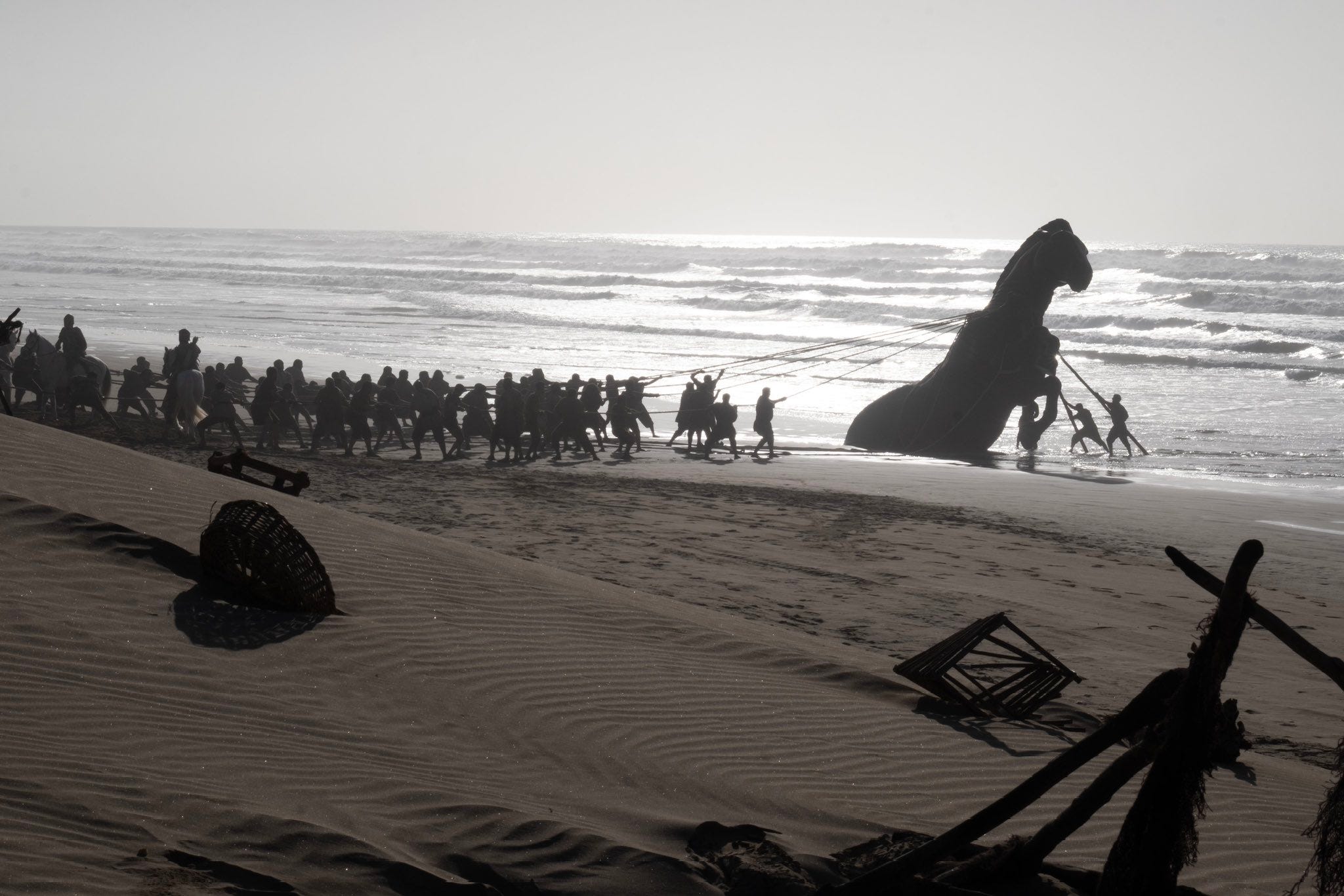
The open sea. Day. The deck of Odysseus' ship.
The ship runs before the wind. The sirens’ rocks fall away astern.
The crew hold their stations, ears stopped with wax. Odysseus is lashed to the mast, spent, head hanging. The ropes have cut into him.
The song has faded. The sea is quiet.
Eurylochus crosses the deck slowly and stands before his captain.
EURYLOCHUSWhat was the sirens' song?
ODYSSEUS All the things you want it to be,
then all the things
you wish you never wished for.The memory takes him. He strains against the ropes, face twisting, agony, terror, longing, all at once.
Eurylochus watches, unable to understand what the song could have shown him.
The struggle passes. Odysseus sits at the mast and speaks, quietly now.
ODYSSEUS It was the delicious itch you go to scratch,
but find it is under the skin
you can’t reach it.
So the delicious itch becomes unbearable.
Told you what you most want,
is what you most can’t have.
And what you most can’t have,
is what you already had, and lost.
It was the song
of all the promises I failed to keep.
And it told me,
I don’t really want to go home.…
Ithaca. Night. The throne hall.
ODYSSEUS sits on the steps below the throne, his back to PENELOPE. Between them lies a screen. He does not turn around.
PENELOPE
Hello traveler.ODYSSEUS
My queen.PENELOPE
        Melantho,
have Eurycleia wash the stranger’s feet.ODYSSEUS
It’s not necessary.PENELOPE
        My husband insisted
        we honor guests as family.
You know Odysseus, my husband?ODYSSEUS
Of course.PENELOPE
From the songs?ODYSSEUS
I was at Troy, ma’am.PENELOPE
The songs probably seem silly.ODYSSEUS
They make me cry.PENELOPE
Why?ODYSSEUS
For what was lost.PENELOPE
The lives?ODYSSEUS
And the years... Everything.EURYCLEIA enters with a basin. She kneels at the beggar’s feet and begins to wash them. His face is turned from her.
PENELOPE
Did you know Odysseus at Troy?ODYSSEUS
I did.PENELOPE
        Was there some...
        detail...
        of how he dressed,
something he wore?ODYSSEUS
He wore a strange pin.PENELOPE
Strange?ODYSSEUS
Beautiful, but out of place.PENELOPE
Describe it.Eurycleia’s hands still. On the beggar’s foot, an old wound, one she treated herself, long ago, before Troy.
Her eyes travel up. She sees his face.
She recoils. Odysseus starts, his foot catches the basin and water spills across the stone.
Eurycleia stares at her king.
Odysseus holds her eyes. A small shake of the head. His hand closes gently over her cheek.
She nods. Composes herself. Murmurs that she will fetch more water, and goes.
Odysseus turns back toward the screen. Still he does not rise, does not look through it.
ODYSSEUS It was a beautiful gold pin,
a figure of Athena encircled by vines.Penelope’s breath catches. Tears come.
PENELOPE
Did he wear it often?ODYSSEUS
He never took it off.She weeps openly now.
PENELOPE
        How is it that you made it home
and Odysseus could not?ODYSSEUS
I’m not home, not yet.PENELOPE
Why not?ODYSSEUS
        It’s not always an easy thing,
        a homecoming.
That’s as true for Odysseus as it is for me.PENELOPE
        The Odysseus I knew
        would have found, or fought
his way back to me no matter what.ODYSSEUS
        What if the Odysseus you knew
        lost his way?
        What if,
        one night,
        in a strange city,
        he saw things
        that made him think
        the home he knew
        couldn’t possibly be there anymore.
Odysseus looks to his left.
Athena sits beside him on the steps. She wears the face of a Trojan priestess. Only he sees her.
ODYSSEUS
        What if,
        when he left the belly of the horse,
        and opened the gates of Troy.
        He saw ten years of rage
        pour into that city in one night.
Troy. That night.
Odysseus moves through his own army as it pours into the city.
Fire climbs the walls. Buildings fall burning. The Greeks kill everything before them.
The throne hall.
ODYSSEUS
        We left them a gift,
        an offering of peace,
        that they took
        into their home.
Beside him, Athena is crying.
He raises one hand, palm half open. She takes it. From the throne, he seems to reach into empty air.
ODYSSEUS
        We violated all that’s ever sacred
        between people.
        We turned the fight into a hunt.
Troy. The statue of Athena.
Odysseus stands beneath the towering statue.
His men drag a Trojan priestess before him. Her face is the face Athena now wears.
They kill her at the feet of her goddess.
A soldier turns his weapon on the statue.
GREEK SOLDIER
Destroy their idols.The statue’s head comes down.
The throne hall.
ODYSSEUS
        To burn the walls of Troy
        was to burn the world entire,
        including his hall.
His hand is still extended.
Athena is gone. He is reaching toward nothing. He lowers his hand.
ODYSSEUS
        What if he knew,
        that very night,
        as he walked through
        fires, anarchy, and pain.
Troy, burning.
The city in full ruin. Flame on every wall.
ODYSSEUS
        And in the days of
        sweaty celebrations to follow,
        what if he knew exactly,
        what he had done.
Troy. The morning after.
Odysseus walks through ash and smoke and the dead.
The throne hall.
PENELOPE
What all of you had done.ODYSSEUS
        One man’s idea,
        one man’s trick,
        to break Zeus’ law forever.
        We lived in a world of palaces,
        and trade, and language,
        blind to its beauty,
        until we broke it.
Penelope studies the stranger’s back through her tears.
PENELOPE
You are the people from the sea?ODYSSEUS
        Yes, my queen.
        The breaking of Zeus’ law
        is spreading like plague.
        Our age of bronze is collapsing,
        and maybe he couldn’t bear
        to see the ruins of what he has done,
        anywhere,
        least of all his home.
A silence.
ODYSSEUS
        Odysseus is alive,
        and he will be here
        when you need him most.
PENELOPE
        Well,
        I have been living in his ruin long enough.
Penelope rises.
She throws open the screen to the great hall and calls down to the suitors: return at dawn.
…
I cried twice in this film, to these two scenes, and both times the same music was playing.
The sirens tell him a truth he cannot bear, and in the throne room he finally repeats it out loud, to the one person it was always about. Everything I want to say about this film lives in the distance between those two moments.
…
Every version of the sirens I grew up with got them wrong, and I didn’t know it until now. Their song was never a melody. When Eurylochus asks his captain what he heard, Odysseus tries to describe the indescribable, and what he describes is desire with a voice. The song gives you everything you want, and then everything you wish you had never wanted. It is an itch that turns out to be under the skin, where no hand can reach it. It tells you that what you want most is what you cannot have, and that what you cannot have is what you already had, and lost. It is every promise he failed to keep, sung back to him. And at the bottom of it, the thing that breaks him: the song tells him he does not really want to go home.
Homer’s sirens promised knowledge. Nolan understood that for a guilty man, knowledge and torture are the same thing. His sirens tempt Odysseus with the truth. And Damon, roped to the mast, plays a man being told the truth about himself with no way to cover his ears. I have seen actors scream in pain before. I have rarely seen one scream in recognition. Eurylochus approaches him in silence, staring at his captain’s agony without a clue what could cause it. The people who love us, watching us suffer something they cannot hear.
The cruelty of the song is what I couldn’t shake. Sirens are supposed to deceive. These ones don’t. He doesn’t really want to go home, and the rest of the film has to discover why.
…
The answer comes in Ithaca, in the scene that undid me completely. Odysseus, disguised as a beggar, sits below his own throne and will not turn around. He has crossed the world to reach this room, and now he cannot look at his wife’s face. Between them lies a screen. Penelope, not knowing him, or perhaps knowing him better than he knows himself, does what her husband always insisted on: she treats the ragged stranger as family and orders his feet washed.
The sacred law of the guest, what the Greeks called xenia, the bond that made a stranger safe at any hearth, protected by Zeus himself, is the foundation of their entire world. It is what made trade possible, and travel, and trust between palaces that would never meet. And the man receiving Penelope’s hospitality is the man who broke it. The Trojan Horse was a gift. That was the trick. The most celebrated piece of cunning in all of storytelling was the weaponizing of welcome itself: an offering of peace that the Trojans, obeying the holy law, carried inside their own walls. Nolan takes the cleverest thing any hero ever did and reframes it as an original sin, and I felt the entire tradition tilt under me when I realized what he was doing. So every kindness Penelope shows the beggar tightens around him like a trap. She is practicing the law he ended. He has to sit there and take it.
Then comes the test of the pin. She asks the stranger whether he remembers some detail of how her husband dressed, and he describes it perfectly: gold, Athena wound in vines, the gift she gave him when he left, the one secret proof they share. He tells her Odysseus never took it off. She weeps at a stranger’s memory of a pin, and what she is really being told, in the only language he can bear to use, is that he kept his promise every single day and still could not come back. Fidelity and failure fastened in the same small piece of gold. And when she asks the unanswerable question, how a stranger made it home when her husband could not, he says: “I’m not home, not yet.” A man saying this in his own hall, his feet in his own basin. Home, this film insists, is a state you have to be fit for. The monsters were never what kept him from home. What kept him away was the night he opened the gates at Troy.
…
Midway through the confession, Odysseus glances to his left, and she is there. Athena, invisible to everyone else, sitting beside him on the steps. Except that Athena, in this film, wears the face of a Trojan priestess, the woman his own men dragged before him and slaughtered at the foot of her goddess’s statue while the idol’s head was hacked from its shoulders.
No other god appears in this film. It leaves open the reading I can’t stop thinking about: that this is not Athena at all. That there is no goddess in the room, only a man’s guilt, so heavy it has learned to wear a face. And the guilt is layered three deep. Guilt for breaking Zeus’s law with a false gift. Guilt that the false gift was a fake tribute to Athena, cunning dressed up as piety. Guilt that a real servant of Athena was butchered because of it. His protector, his accuser, and his victim now share one face, and he can never receive her comfort without looking straight at what he did.
And she is crying. Whatever she is, goddess or ghost or conscience, she sits beside him on the steps and weeps at his confession, as if the story of Troy is unbearable even in heaven. When he lifts his open hand and she takes it, I lost it, fully, in a crowded theater, because the gesture holds everything at once: grief, love, and an absolution that never arrives. A few lines later she is gone and his hand is still raised, holding air. A man reaching for grace a moment after it leaves the room.
Even the gods cry at this story. Some stories are so sad that the beings who caused them cannot listen without weeping.
…
What you most want is what you most can’t have; what you most can’t have is what you already had, and lost. In the hall we learn what that means. What he had was a world. Palaces, trade, language, the law that made a stranger safe, and a wife inside all of it, waiting. What he lost is the same list, because he burned the roots of it at Troy. His civilization was beautiful and no one living inside it could see it, because that kind of beauty is invisible while it works. Nobody wakes up marveling that trust held overnight. Its loveliness is only revealed in the breaking, the way you never see a vase so clearly as in the instant it leaves the shelf. Troy in flames was the one moment the whole beauty of the bronze world became visible, and seeing it was the price of destroying it. Odysseus is not haunted only by what he did, but by the fact that doing it was how he finally saw.
Penelope names what he has become. The people from the sea. The Sea Peoples were real, or real enough: the unnamed raiders who appear in the records just as the entire Bronze Age Mediterranean, Mycenae, the Hittites, Troy itself, collapses within a generation, for reasons nobody has ever fully explained. Nolan proposes a cause fit for tragedy. One man’s trick broke the guest-law, and the breaking spread like plague. Odysseus is patient zero of a dying civilization, wandering the wreckage of an order he personally ended, unable to face the last unburned hall on earth because it is his own.
…
All of this rides on the music. There is no orchestra in this film. Nolan forbade one, on the reasonable grounds that no orchestra existed in the Bronze Age, and so Göransson built the score out of the ancient world itself: the aulos and the lyre, reconstructed from urns and carvings, over the toll of bronze gongs. The piece that plays over both scenes above is called Sirens, and it is carried by the aulos in C Aeolian.
Aeolus never appears in this film. In Homer, he is the keeper of the winds, the king who bags up every contrary gust and hands them to Odysseus so that a clean breeze can carry him home. Nolan cut the character. But the mode the theme is written in bears his family’s name, Aeolian, the mode of the Aeolian Greeks, the people whose name runs back to Aeolus, and it is played on an instrument that is nothing but breath, wind shaped by a human mouth through ancient pipes. I don’t know whether Göransson intended it, and I don’t need him to. Aeolus is not missing from this film. The god of the winds became the wind in the score, and every time the theme rises under Odysseus, the old king is doing his one kindness again, blowing a broken man toward Ithaca.
The character became the music. I can’t think of a more beautiful way to cut a scene from a script.
The lyre carries the theme’s other half, because Nolan wanted its plucked string to stand in for the drawing of Odysseus’s bow. A lyre and a war bow are near kin. A frame, a string under tension, a sound released by the fingers. Homer knew it; in the poem, Odysseus strings the great bow the way a musician strings a lyre. So under the confession, every note is the ghost of his weapon, violence transposed into music. The film’s recurring image: Odysseus hunting with a bow he draws slowly, letting the pull of the string be heard, a small warning, because a hunt is not a fight and even a deer deserves its chance. His confession turns on the admission that at Troy the Greeks stopped fighting and started hunting. Men, women, children, run down like game, no warning given. The man who extends fairness to an animal denied it to a city. That is the sin, measured precisely, and the lyre keeps measuring it, note by note, under everything.
…
The suitors’ crime, feasting for years on the hospitality of a house whose master cannot refuse them, is a violation of xenia stretched over years, the same law Odysseus broke in a single night. The revenge, when it comes, is satisfying the way the old story has always been satisfying. But in this telling it is also something stranger and sadder: the great breaker of the guest-law spending his homecoming as its avenger, punishing in his own hall the sin he committed at the scale of a civilization. Whether that is justice or penance, the film lets you decide. I think it is a man trying to put one wall of the world back up.
And it is Penelope who forces it. The beggar’s confession, the promise that Odysseus lives and will come when she needs him most, is answered with the line that cuts through the entire scene: she has lived in his ruin long enough. His grief has had a population of two all along. Her twenty years inside his self-exile were a siege, and she is done. So she rises and throws open the screen, the barrier that stood between them the whole scene, and summons the suitors for dawn. Ending his hiding and calling his enemies are one gesture. Only later did I understand what she had done. A man drowning in guilt does not need forgiveness first. He needs to be needed. He promised to come when she needed him most. By morning, she has arranged to need him.
…
Near the end, the horse burns. And over the flames, the thought the entire film has been carrying: that this tale will be remembered in song, and the mistakes inside it will be forgotten, and repeated. The songs, the beggar admitted on the steps, make him cry, for what was lost, the lives and the years and everything. Now we see why. The songs are the problem. They kept the glory and dropped the warning. Three thousand years of retellings made the horse the cleverest trick ever played, and forgot that it was the night trust died.
Nolan’s film is a new song that tries, for once, to keep the warning in.
I don’t know if it will work. The final image says it won’t, that we will hum the tune and repeat the mistake, that this is what we are.
But I know that I sat in the dark while a weeping goddess who may only be a man’s guilt held his hand on the steps of a ruined home, and that the music carrying the moment was breath through ancient pipes, in a mode named for the keeper of the winds, still trying, after all these centuries, to blow somebody home.
Even the gods cry at this story. I did too.