A Memory of a Memory
On Kane Parsons’ Backrooms, and the rooms we cannot stop building

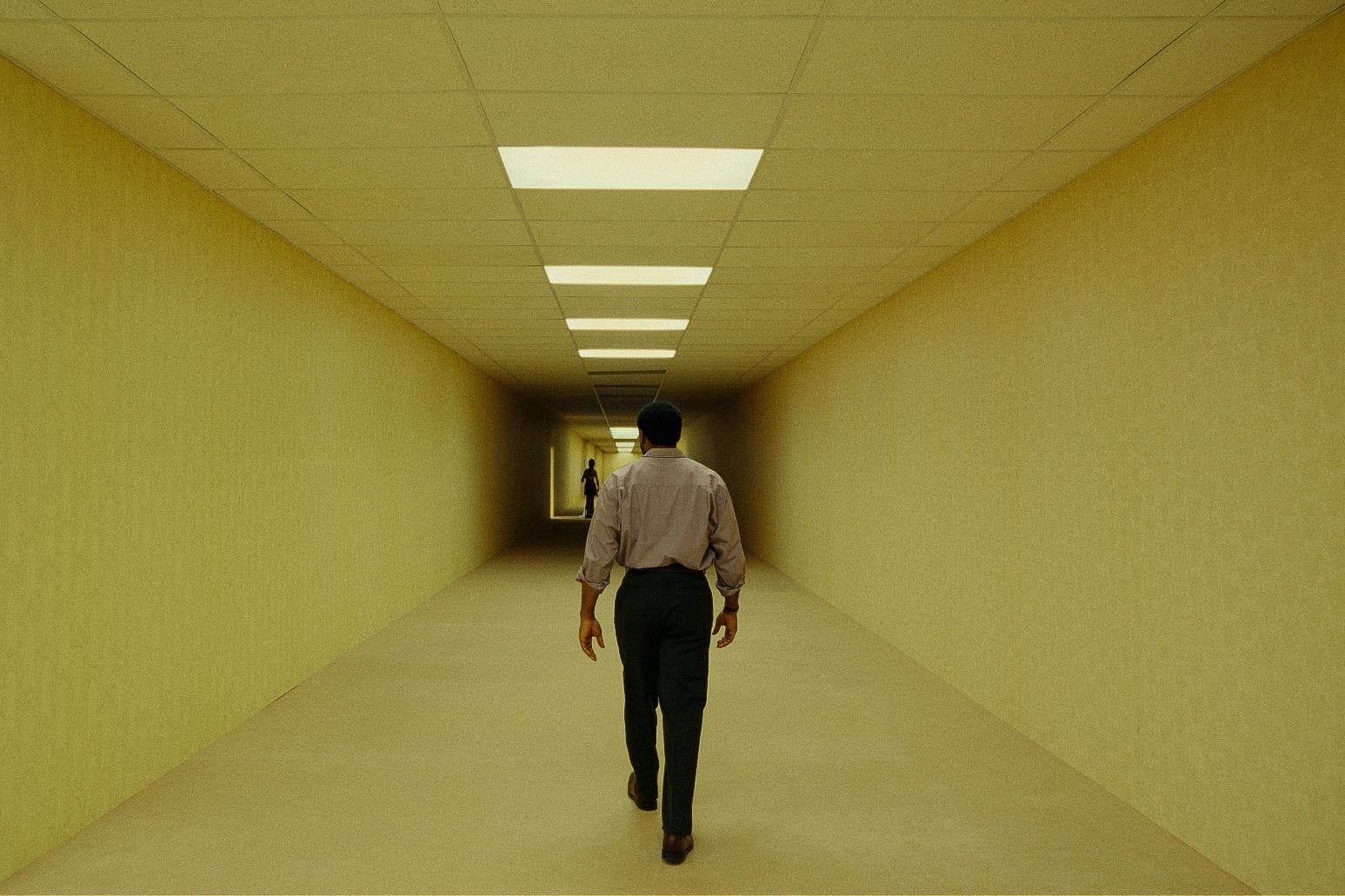
Imagine describing a dog, Clark says, to someone who has never seen one. Then ask them to draw it. What comes out will be wrong in a way that is hard to name. The right number of legs, maybe, the general idea of a tail, and underneath it all something deeply, quietly incorrect. A dog assembled from a description of a dog. That, he is saying, is what the rooms are. That is what they are made of.
I have been turning that line over since I left the theater yesterday, because the line reaches past the rooms entirely. It is the most accurate description of human memory I have ever heard in a film, and it is what the entire film is built around. Kane Parsons has made a horror film where the monster is the thing your own mind does to your own life, every single day, without asking.
Start with what the film gets right in its choice of who discovers the rooms in the first place. An MRI company. Of all the machines a screenwriter could have reached for, the door is opened by the one machine we have ever built that can watch a living brain think while leaving the skull closed. A screenwriter who wanted a brain on screen could not have chosen better. The Backrooms are a brain, and the film is an MRI of grief. Late in the film, the researcher Phil makes it almost explicit, telling Mary that the place seems to work as an echo chamber for memories, which is why everything inside it arrives imperfect, misremembered, slightly wrong.
And the brain it is scanning belongs to a man who keeps walking back into a room he has already left.
Clark is a failed architect, a man whose whole training was the design of spaces people move through, now running a discount furniture store and sleeping in it, put out of his own house by a wife who could not live with his drinking, his rage, his blame of everything and everyone around him, including himself. He is the one who gets lost in a space that has no design at all, only repetition. He maps the rooms as he goes, the way you would map anything you were trying to control, and the maps fail him, because the rooms rearrange themselves behind his back in answer to him. His exploration of the Backrooms is an exploration of himself, and what he finds, in room after identical room, is that he has been here before, that he is always here, that the architecture of a man who keeps himself the same is just the one hallway forever.
Here is what neuroscience actually knows about the thing Clark is trapped inside. We tend to imagine memory as storage. A recording made once and replayed on demand, fading slowly the way a photograph yellows. The truth is more unsettling. In 2000, a researcher named Karim Nader showed something that overturned a century of assumption: when you recall a memory, you pull it out of storage, and in that moment it turns unstable, physically, chemically labile, held together by proteins that have to be built again before the memory can be set back down. Recall opens the file for editing. And whatever state you are in when you open it, whatever you now believe, fear, or want, gets written into the memory before it is filed away again as though it had always lived there.
The memories you have revisited the most often are the ones that have drifted furthest from what happened. Every act of remembering has rewritten them a little. The cherished story you have told a hundred times, the wound you keep returning to, the moment you are most certain of: that certainty is the fingerprint of how many times you have handled it, and handling is editing. The faithful memories are the ones you have left alone in the dark. The ones you love, and the ones you cannot stop touching, are by now mostly drawings of dogs.
This is what Mary, the therapist, is doing in the opening scene between her and Clark. She has Clark replay the moment his marriage ended, his wife putting him out of the house, casting herself in the wife’s place, asking him to feel the rage and walk back into the room. A clinician would recognize it at once: this is the logic of reconsolidation therapy, the real treatment that grew out of Nader’s discovery, where you bring a trauma carefully back into its unstable state precisely so that something new can be written into it while it is still soft. You reopen the wound on purpose, in a safe room, so it can close in a better shape. The whole hope of it rests on one fragile condition. This time, while the memory is open and rewritable, you put something kinder in.
Clark walks back into the room. And he puts the rage in, as he always has, and the door closes on it again, harder than before.
There is a second thing the brain does, underneath remembering, and the film is built on this one too.
Your brain works as a prediction engine that mostly invents the world and uses your senses only to check its guesses. The physician Hermann von Helmholtz saw this in the 1860s and called perception unconscious inference. The raw signal from your eyes is patchy and full of holes. There is a real blind spot in each eye, a gap where the optic nerve punches through the retina, and you never see it, because the brain quietly paints over the hole with its best guess. You walk around inside that guess and call it the world.
Where there is a gap, the brain fills it. It has to. It reaches for something plausible, a detail borrowed from a similar day, a guess that fits the shape of the story, and it slips that invention back to you without ever telling you it was invented. Clinicians call this confabulation, and the person believes it completely. It is the autocomplete of consciousness, finishing your sentences in your own voice and returning them to you as memory.
The film has a name for the gap-filling, drawn from its own mythology. The figures that populate the rooms are called Still Lifes, and the film is exact about what they are: the Backrooms’ failed attempts to replicate people. The brain trying to draw a face from a description of a face. Look at how they fill Clark’s final descent, the office reassembled out of recollection, and in the room around him the figures warped, smeared, unfinished, present but melted, the way every face goes soft in a dream and in a memory more than a few years old. The brain kept the emotional architecture of the scene, the room, the witnesses, the verdict, and confabulated everything it could not be bothered to preserve, which is to say everything that was not the pain. The Backrooms render memory exactly as it is: sharp where it hurts, and melting everywhere else.
And here is the detail that turns the whole film into an argument about memory rather than a story about a place. The explanation of what the rooms are and how the copies work comes from Clark, and Clark, by this point, has come undone. He is the narrator, and he is the least reliable witness imaginable, raving inside the very structure he is describing. We are being handed a theory of memory by a man whose own memory has folded in on itself. The account of the rooms is itself a memory of a memory, told by someone who can no longer tell the recording from the rewrite. Even the explanation is unreliable, because explanations are memories too, and memories are drawings of dogs.
Then there is the monster. The film gives it a name pulled straight from the most pathetic and human corner of Clark’s life. Captain Clark, a towering, mutated version of the pirate costume the real Clark wears to film cheap commercials for his sinking furniture store, the Ottoman Empire, the joke shop kingdom of a man with no customers and no house to go home to. That is the thing that rises out of his own recollection and kills him.
The predictive brain has a failure mode, and it has a name now. When the system pours too much confidence into its own fearful predictions, when it grows so certain of threat that harmless, ambiguous signals read as danger, the brain begins, in the language of the researchers, to hallucinate danger. Anxiety, in this model, is a prediction so overconfident it stops consulting the world at all. The mind builds the threat and then walks out to meet it. Captain Clark is exactly that, the film says so outright, a physical manifestation of Clark’s rage and aggression. It is the shape his fury takes after he has rehearsed it enough times, written and rewritten it into the same memory so often, that it finally gathers the confidence to stand up and cross the room.
The detail that tells me Parsons understands exactly what he is doing is that the monster is Clark. A stranger would have been a mercy. The comfortable king of a kingdom made of his own unchanged habits, the pirate self he dressed up as and retreated into, carries the identical rage as the original, because of course it does. The copy has your hands. Clark goes looking, in the rooms, for a version of himself that has stopped hurting, and what finds him instead is the version that never stopped, wearing his costume, killing him with his own anger because it is, precisely and inescapably, him.
Mary lives. The way she lives is another point in the film, and it is worth being precise about it, because the rooms nearly close over her too.
Clark takes her captive and drags her down into the recreated office, where he tells her he belongs here, that the Backrooms suit him better than the empty store and the lost house, and demands that she validate the bitterness he has chosen. He is preparing to let her go, on the condition that he be allowed to stay, when Captain Clark comes through the door and tears into him. Mary runs. She does not talk her way out and she does not reason the rooms into releasing her. She fights, and the thing she fights with is a piece of cement.
The cement is a handprint. As a child, Mary pressed her hand into the wet concrete outside her house alongside her mother’s, and she saved the broken piece of it when the house was demolished, and she has kept it on her desk and her nightstand ever since, glancing at it as the one fixed point in her life. Her mother was a shut-in who papered over the windows of their home and would not let Mary go outside. Mary grew up inside a claustrophobic, windowless box, which is to say she grew up in a Backroom before she ever found the exit, raised inside someone else’s sealed and frightened mind. The whole reason she became the kind of therapist who talks to her patients about windows, about opening one, about how a person practiced in being hurt will seal themselves in and call it safety, is that she was trying, in every session, to do for someone else the thing she could not do for her mother. She beats back the manifestation of Clark’s rage with the one piece of her childhood she managed to carry out of the rubble, and she escapes through a passage too narrow for the monster to follow.
And this is where the neuroscience and the film say the same thing at the same time. The reconsolidation that trapped Clark is the reconsolidation that frees Mary. A memory is at its most changeable in the very instant you dare to recall it. The labile moment is the dangerous one and the healing one at once, the same moment wearing two faces. Reopen the wound while rehearsing the same rage, and you carve the groove deeper, and the hallway repeats. Reopen it carrying something truer, the way Mary carries that fragment of cement, the proof that she was once a child whose hand fit into her mother’s, and the memory sets in a slightly better shape, and the room grows a door in a wall that was blank a breath ago. The exit and the deepest cell are the same act, performed in two different spirits. That is the most frightening thing the film has to say and the most hopeful thing the film has to say, and they turn out to be one sentence.
The film refuses to let her go clean. After Mary escapes, the camera drifts back down through the layers of the rooms and finds, sitting alone in the dark, a warped Still Life of Mary, a copy left behind inside the Complex forever. She got out. Something that was her did not. You do not pass through a thing like that and leave nothing of yourself in it. Everyone who walks into the rooms leaves a copy behind, and the copy stays, sitting quietly in a room with its face warped, for as long as the rooms exist. We carry our pasts out with us, and we also leave versions of ourselves trapped at every age we have ever been, in every room where something happened to us. Both things are true at the same time, and neither one cancels the other out. You get away, and you never fully get away.
Near the end, Phil says that the most important thing in the world is to understand the rooms even a little better. Even just a little. When I first heard it yesterday, I missed why he would stake everything on so small a gain. I understand it now. He is reaching past the rooms to the oldest question there is, the one the MRI was invented to chase. How does a wet handful of cells, a few pounds of tissue that has never once touched the world directly, generate this: a self, a history, a grief, a kingdom, a monster, a door? How do you get from a hallway to a haunting? How do you get from neurons to the feeling of standing inside your own past while it warps around you? Nobody knows, and nobody ever has. To understand even a little more about how the rooms work would be to understand a little more about how we work, which may be the most important thing we could ever do and the least likely thing we ever will.
Parsons built enormous practical sets for this film, and the phrase people keep landing on for them holds a contradiction at its center: wide-open claustrophobia. Endless space that crushes. I cannot think of a better description of a human mind. There is no wall you can reach in there, no edge, no last room, and there is also no way out, no air, only more of yourself in every direction. We are each of us walking around inside a structure with infinite rooms and no outside, rearranging the furniture of things that already happened, certain we remember them, drawing dogs from descriptions of dogs.
The mercy, and the film does allow a mercy, just barely, is that the rooms are still under construction. They are unfinished. Every time we go back in, the walls go soft. We can carve the same hallway deeper, or we can carry in one true thing, a hand that once fit inside another hand, and let the architecture move, and set a window where the windows were papered over, and climb out toward whatever waits on the far side of a self we have not finished making. We will leave a copy behind when we go. That is the price. But we get to choose, each time the wall goes soft, whether the one who walks out is the same one who walked in.
Imagine describing a dog to someone who has never seen one.
Now imagine the someone is you, and the dog is your own life, and you have been drawing it from memory all along.
I liked your analysis and the details.